Reseller Integration Overview
Understand how partners provision VASP tenants and proxy CryptoSwift API access.
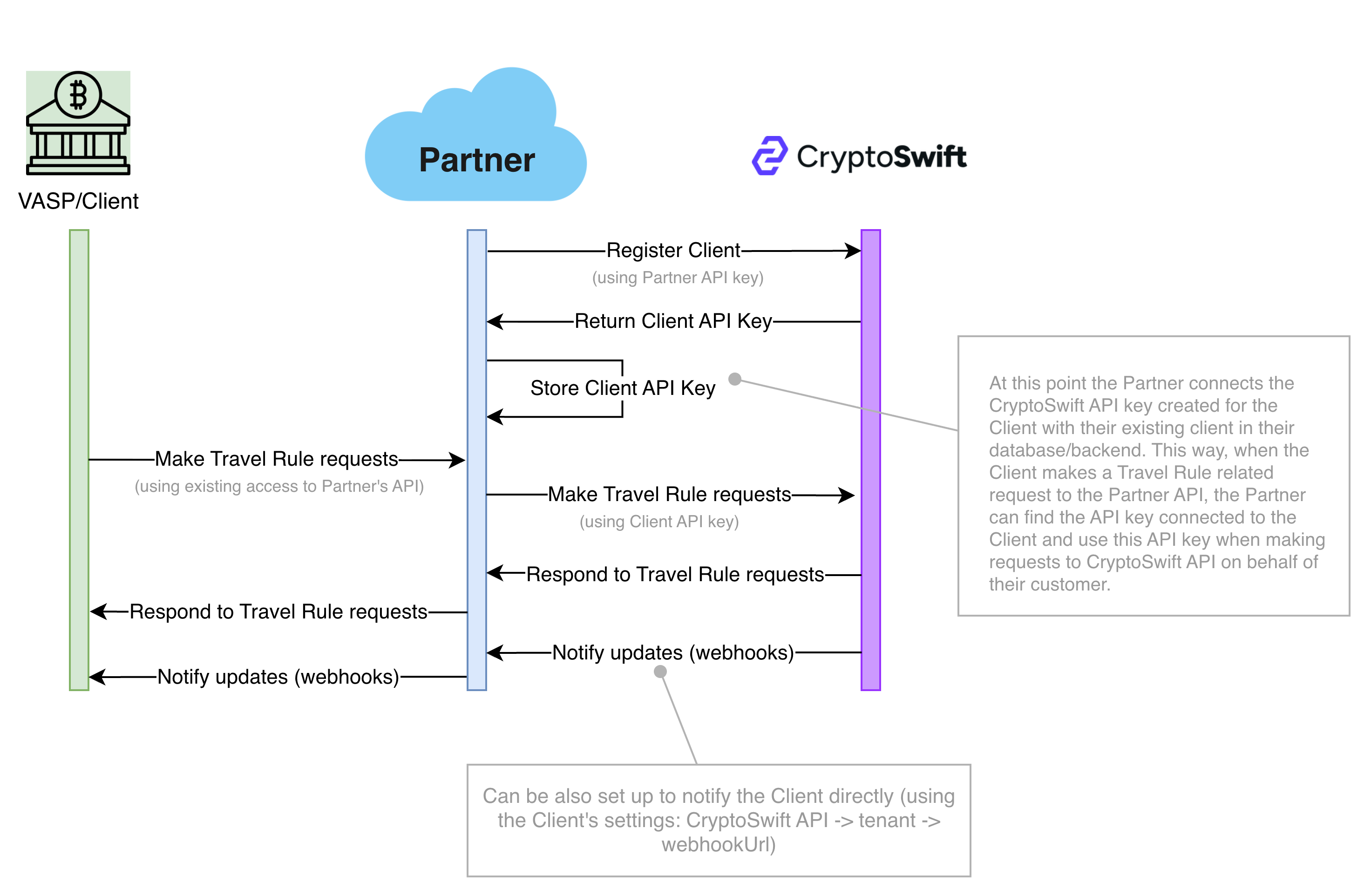
The reseller integration is designed for partners that want to offer CryptoSwift Travel Rule capabilities inside their own product. CryptoSwift adds a Partner API layer on top of the regular CryptoSwift API so the partner can provision VASP tenants, receive tenant-specific API keys, and then act on behalf of those VASPs through the regular API.
How the Integration Works
The Partner API is used for platform-level administration. It lets the partner create and list VASP tenants in CryptoSwift using a dedicated Partner API key in the X-Partner-Api-Key header.
When a VASP tenant is created, CryptoSwift generates a regular tenant API key for that VASP. The partner stores this VASP-specific API key securely and maps it to the corresponding customer, workspace, or organization in the partner platform.
After that, the partner uses the VASP-specific API key with the regular CryptoSwift API and the standard x-api-key header. This is how the partner can submit Travel Rule messages, create wallet verifications, provision dashboard users, or call other tenant-level CryptoSwift endpoints on behalf of a specific VASP.
End-to-End Process
| Step | API layer | Authentication | Result |
|---|---|---|---|
| 1. Register or list VASP tenants | Partner API under /partners/* | X-Partner-Api-Key | The partner manages the VASPs connected to its reseller account. |
| 2. Receive tenant API keys | Partner API response | X-Partner-Api-Key | CryptoSwift returns a regular API key for each VASP tenant. |
| 3. Act on behalf of a VASP | Regular CryptoSwift API | x-api-key: <vasp-specific-api-key> | The partner calls tenant-level API endpoints for the selected VASP. |
Why This Model Matters
This split keeps responsibilities clear:
- The Partner API is for managing the partner relationship and provisioning VASP tenants.
- The regular CryptoSwift API is for tenant-level Travel Rule operations.
- Each VASP has its own API key, so requests remain isolated by tenant even when the partner proxies them through one platform.
In a white-label setup, the VASP does not need to call CryptoSwift directly. The partner can expose its own product UI or API, look up the correct VASP-specific CryptoSwift API key internally, and forward the request to CryptoSwift with the original payload structure intact. Partners can also choose to let VASP tenants call CryptoSwift directly with their own tenant API key when that fits the integration model.